

How to Choose the Right Toy According to Your Childs Age

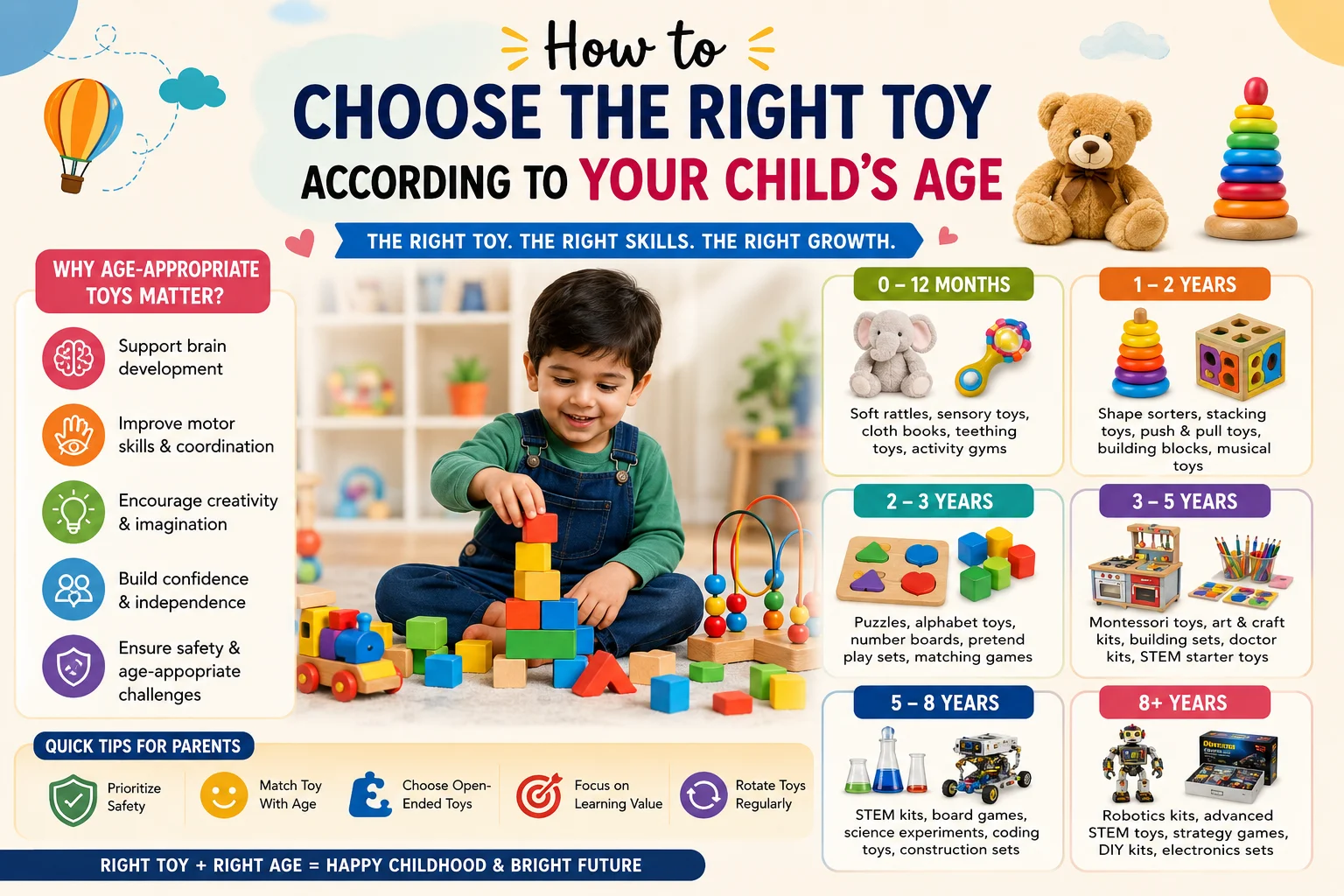
Table of Contents
One of the most common questions parents ask is how to choose the right toy according to your childs age. With thousands of toys available in stores and online, selecting the perfect one can feel overwhelming. Bright colors, attractive packaging, and popular trends often influence buying decisions, but the most important factor is whether the toy is suitable for your child’s developmental stage.
Every child grows at their own pace, but children of similar ages generally develop certain physical, cognitive, emotional, and social skills. Choosing age appropriate toys helps children learn naturally while keeping them safe and engaged. The right toy can encourage creativity, improve problem-solving abilities, strengthen fine motor skills, build confidence, and support healthy brain development.
Whether you’re shopping for a newborn, a curious toddler, or a preschooler, this complete guide explains how to choose the right toy according to your childs age, what features to look for, and which educational toys for kids provide the greatest developmental benefits
Why Choosing Age-Appropriate Toys Matters
Children experience rapid growth during their early years. Their interests, abilities, and learning styles change quickly, which means the toys they play with should also evolve.
A toy that is too simple may not keep a child interested, while one that is too advanced can lead to frustration or even safety risks.
Age-appropriate toys are carefully designed to match a child’s developmental stage. They encourage children to explore new skills without feeling overwhelmed.
Benefits of Choosing the Right Toy
When parents select toys based on age, children are more likely to:
- Learn through hands-on play
- Stay engaged for longer periods
- Develop creativity and imagination
- Improve concentration and memory
- Build confidence through success
- Strengthen fine and gross motor skills
- Improve communication and social interaction
Educational play is most effective when toys match the child’s current abilities while also encouraging them to learn something new.
Why Educational Toys Are Better Than Regular Toys
Many traditional toys provide entertainment, but educational toys for kids combine fun with meaningful learning.
Educational toys encourage children to:
- Think independently
- Solve problems
- Recognize patterns
- Build vocabulary
- Improve logical reasoning
- Develop creativity
For example, building blocks teach balance, engineering concepts, and spatial awareness, while puzzles strengthen memory and concentration.
The best toys entertain children while quietly helping them develop essential life skills.
Factors to Consider Before Buying a Toy
Before purchasing any toy, parents should think beyond appearance and price.
Here are the most important factors to consider.
1. Age Recommendation
Always check the manufacturer’s recommended age.
These recommendations are based on:
- Safety standards
- Child development research
- Skill level
- Size of toy parts
Never ignore age labels, especially for babies and toddlers.
2. Safety
Safety should always be the top priority.
Choose toys that:
- Have rounded edges
- Are made from non-toxic materials
- Do not contain harmful chemicals
- Are durable and well-constructed
- Have no small detachable parts for young children
Look for toys that meet recognized safety standards and buy from trusted brands or retailers.
3. Learning Value
Ask yourself:
“What will my child learn from this toy?”
The best toys for child development encourage children to think, create, build, explore, and solve problems.
4. Open-Ended Play
Open-ended toys have no single correct way to play.
Examples include:
- Building blocks
- Clay
- Wooden toys
- Magnetic tiles
- Art supplies
These toys grow with your child and remain interesting for years.
5. Child’s Interests
Observe what naturally excites your child.
Some children love:
- Drawing
- Building
- Music
- Vehicles
- Animals
- Role play
Buying toys that match their interests keeps them engaged and encourages independent learning.
Best Toys for Babies (0–12 Months)
The first year of life is full of rapid growth. Babies begin developing their senses, recognizing faces, responding to sounds, and learning how to grasp objects.
At this stage, toys should focus on sensory exploration rather than complex activities.
Recommended Toys
- Soft rattles
- Sensory balls
- Cloth books
- Musical toys
- Teething toys
- Activity gyms
- Soft stacking rings
- High-contrast picture cards
Skills Developed
These toys help babies develop:
- Vision
- Hearing
- Touch
- Hand-eye coordination
- Muscle strength
- Curiosity
- Early communication
Simple interactions such as shaking a rattle teach babies that their actions create results, introducing the concept of cause and effect.
Safety Tips
For babies under one year:
- Avoid toys with small parts.
- Choose BPA-free materials.
- Wash toys regularly.
- Avoid sharp edges.
- Supervise playtime whenever possible.
Best Toys for Toddlers (1–2 Years)
Between one and two years of age, children become much more active. They begin walking, climbing, talking, and exploring everything around them.
This is the ideal time to introduce learning toys for toddlers that encourage movement and problem-solving.
Recommended Toys
- Shape sorters
- Stacking cups
- Push-and-pull toys
- Building blocks
- Musical instruments
- Simple puzzles
- Ride-on toys
- Large crayons
- Ball games
Developmental Benefits
Children improve:
- Balance
- Coordination
- Vocabulary
- Color recognition
- Shape recognition
- Fine motor skills
- Gross motor skills
Parents can support learning by naming colors, counting objects, and encouraging children to describe what they see.
Best Toys for Children (2–3 Years)
By age two or three, children become more curious and imaginative. They begin asking questions, solving simple problems, and pretending to be different characters.
This is one of the best stages to introduce educational toys that stimulate creativity and independent thinking.
Recommended Toys
- Building Blocks
- Alphabet Puzzles
- Number Boards
- Wooden Puzzles
- Pretend Play Kitchen Sets
- Doctor Kits
- Art & Craft Supplies
- Magnetic Drawing Boards
- Matching Games
- Animal Figures
Skills Developed
Children begin strengthening:
- Language development
- Creativity
- Memory
- Problem-solving
- Fine motor skills
- Imagination
- Social interaction
- Emotional understanding
Pretend play becomes especially valuable at this stage because it teaches empathy, communication, and confidence.
Signs You’ve Chosen the Right Toy
Parents often wonder whether a toy is truly beneficial.
Here are some positive signs:
- Your child plays with it repeatedly.
- They discover new ways to use it.
- They remain focused for longer periods.
- They ask questions during play.
- They become more confident.
- They solve simple challenges independently.
- They enjoy learning without becoming frustrated.
If a toy encourages curiosity, creativity, and exploration, it is likely supporting healthy development.
Quick Buying Checklist
Before purchasing any toy, ask yourself:
✔ Is it suitable for my child’s age?
✔ Is it safe and made from quality materials?
✔ Does it encourage learning?
✔ Can my child play with it in different ways?
✔ Will it remain useful as my child grows?
If the answer is “yes” to these questions, you’re likely making a smart choice.
Best Toys for Preschoolers (3–5 Years)
The preschool years are one of the most important stages in a child’s development. Between the ages of 3 and 5, children become more independent, curious, and imaginative. They start asking questions about everything around them, enjoy role-playing, recognize letters and numbers, and begin developing problem-solving skills.
This is the ideal age to introduce age appropriate toys that combine learning with fun.
Recommended Toys for 3–5 Years
- Building Blocks
- Alphabet Learning Toys
- Number Learning Games
- Montessori Toys
- Puzzle Toys
- Pretend Play Kitchen Sets
- Doctor Kits
- Magnetic Tiles
- Art & Craft Kits
- Musical Instruments
- Story Books
- Matching Games
These educational toys for kids help children develop both academic and life skills before they begin formal schooling.
Skills Developed
At this stage, children improve:
- Language and vocabulary
- Creativity
- Imagination
- Fine motor skills
- Logical thinking
- Social interaction
- Memory
- Problem-solving
- Emotional intelligence
Pretend play toys are especially valuable because children learn how to communicate, share responsibilities, and express emotions while acting out real-life situations.
Best Toys for Children (5–8 Years)
Children between five and eight years old enjoy more challenging activities. Their attention span increases, and they become interested in learning how things work.
Instead of simple matching games, they now enjoy activities that require planning, creativity, and teamwork.
Recommended Toys
- Advanced Building Blocks
- STEM Learning Toys
- Science Experiment Kits
- Construction Sets
- Coding Toys
- Strategy Board Games
- Globe and Geography Games
- Educational Card Games
- DIY Craft Kits
- Beginner Robotics Kits
These toys encourage children to think critically and solve increasingly complex problems.
Skills Developed
Children strengthen:
- Analytical thinking
- Decision-making
- Scientific reasoning
- Creativity
- Engineering concepts
- Teamwork
- Leadership
- Communication
- Patience
At this age, children also enjoy learning through projects rather than simple activities.
Best Toys for Children (8+ Years)
Older children seek greater independence and enjoy activities that challenge their creativity and intelligence.
The best toys should inspire exploration instead of providing ready-made entertainment.
Recommended Toys
- Robotics Kits
- Coding Games
- Advanced STEM Kits
- Electronics Projects
- Strategy Games
- Chess
- DIY Science Kits
- Art & Design Sets
- Mechanical Building Sets
- Puzzle Challenges
These toys prepare children for future learning by encouraging curiosity, experimentation, and independent thinking.
Skills Developed
Older children improve:
- Leadership
- Planning
- Innovation
- Creative thinking
- Engineering skills
- Coding basics
- Scientific observation
- Research abilities
Parents should encourage children to explain their projects and share what they have learned.
Indoor Toys vs Outdoor Toys
A healthy childhood includes both indoor and outdoor play.
Each type offers unique developmental benefits.
Indoor Toys
Examples include:
- Building Blocks
- Puzzle Toys
- Art & Craft Kits
- Reading Books
- Alphabet Toys
- Number Games
- Pretend Play Sets
Benefits
Indoor toys help improve:
- Concentration
- Creativity
- Fine motor skills
- Language development
- Problem-solving
- Memory
These toys are excellent for rainy days and quiet learning sessions.
Outdoor Toys
Examples include:
- Bicycles
- Scooters
- Balls
- Sports Equipment
- Jump Ropes
- Ride-on Toys
- Garden Play Sets
Benefits
Outdoor play improves:
- Physical fitness
- Balance
- Coordination
- Confidence
- Teamwork
- Social interaction
Children who spend time outdoors often sleep better and develop healthier habits.
Educational Toys vs Electronic Toys
Many parents wonder whether electronic toys are better than traditional learning toys.
The answer depends on how the toy encourages learning.
Educational Toys
Educational toys require children to think, imagine, and solve problems.
Examples include:
- Wooden Blocks
- Puzzles
- STEM Kits
- Montessori Toys
- Pretend Play Sets
Benefits
- Active learning
- Better creativity
- Stronger concentration
- Hands-on exploration
- Independent thinking
Electronic Toys
Electronic toys often include lights, sounds, and interactive features.
Some can support learning, but they should not replace active play.
Advantages
- Interactive learning
- Music and language practice
- Educational games
Disadvantages
Overuse may reduce opportunities for:
- Imaginative play
- Problem-solving
- Physical activity
- Parent-child interaction
A balanced combination of educational toys and limited electronic learning tools is the best approach.
Complete Buying Guide
Choosing the right toy isn’t about buying the most expensive product.
Instead, parents should focus on long-term learning value.
1. Buy According to Developmental Stage
Children develop at different speeds.
Choose toys that are slightly challenging but not frustrating.
A toy should encourage learning without making the child feel overwhelmed.
2. Prioritize Safety
Always check for:
- Non-toxic materials
- Smooth edges
- Durable construction
- Strong packaging
- Safety certifications
Never compromise on safety to save money.
3. Encourage Open-Ended Play
Open-ended toys allow children to create something different every day.
Examples include:
- Blocks
- Clay
- Magnetic Tiles
- Wooden Toys
- Art Supplies
These toys continue supporting learning as children grow.
4. Buy Quality Instead of Quantity
Many parents believe more toys create better learning opportunities.
In reality, children often become distracted when they have too many choices.
A smaller collection of high-quality toys encourages deeper engagement.
5. Rotate Toys
Instead of buying new toys every month, rotate existing toys every few weeks.
Benefits include:
- Increased excitement
- Better concentration
- Less clutter
- More creative play
Toy rotation also helps children appreciate what they already have.
6. Observe Your Child’s Interests
Every child is different.
Some children love:
- Vehicles
- Animals
- Art
- Music
- Building
- Science
- Storytelling
Choose toys that match their natural curiosity.
Children learn faster when they’re interested in the activity.
Toy Safety Tips Every Parent Should Follow
Regardless of age, toy safety should always come first.
Follow these guidelines:
- Read age recommendations carefully.
- Avoid toys with sharp edges.
- Check for loose or broken parts regularly.
- Wash toys frequently.
- Store toys properly after use.
- Supervise younger children during play.
- Replace damaged toys immediately.
- Keep batteries out of children’s reach.
Teaching children how to use toys responsibly also helps prevent accidents.
Common Mistakes Parents Make While Buying Toys
Many parents unintentionally choose toys that provide little educational value.
Here are some common mistakes to avoid:
Buying Toys Only Because They’re Popular
A trending toy isn’t always the right choice for your child.
Focus on learning value instead of popularity.
Ignoring Age Recommendations
Buying advanced toys too early often causes frustration.
Similarly, toys that are too simple may become boring quickly.
Choosing Toys That Do Everything Automatically
When a toy talks, sings, and performs every action on its own, children become passive observers.
The best toys encourage children to participate actively.
Buying Too Many Toys
More toys don’t necessarily mean more learning.
Children benefit more from a carefully selected collection than from overflowing toy boxes.
Forgetting About Long-Term Value
Some toys entertain children for only a few days.
Choose products that can be used in multiple ways and continue supporting learning as your child grows.
Expert Tips for Parents When Choosing Toys
Choosing the right toy is about more than simply buying something that keeps your child busy. The best toys inspire curiosity, encourage creativity, and help children learn through hands-on experiences. Parents play a vital role in making educational toys more effective by participating in play and creating a positive learning environment.
Here are some practical tips to help you get the most value from every toy you buy.
1. Spend Time Playing Together
Children learn more when parents are involved. Even 20–30 minutes of daily playtime can improve communication, confidence, and emotional bonding.
Instead of giving instructions all the time, ask questions such as:
- “What are you building?”
- “Can you make it taller?”
- “What happens if we try another way?”
- “Can you tell me a story about your toy?”
These conversations help develop language skills and critical thinking.
2. Let Your Child Explore Independently
Avoid solving every challenge for your child.
Whether they’re building a tower, completing a puzzle, or sorting shapes, allow them to experiment and make mistakes. Independent problem-solving strengthens confidence and cognitive development.
3. Rotate Toys Instead of Buying New Ones
Children often lose interest when all their toys are available at the same time.
A toy rotation system keeps play exciting.
For example:
Week 1
- Building Blocks
- Alphabet Toys
- Shape Sorters
Week 2
- Puzzle Toys
- Pretend Play Sets
- Musical Toys
Week 3
- STEM Toys
- Art & Craft Kits
- Number Games
Rotating toys every two weeks keeps children engaged while reducing clutter.
4. Encourage Open-Ended Play
Avoid telling children exactly how they should play.
Instead of saying:
“Build this exact house.”
Try saying:
“What can you build today?”
Open-ended questions encourage creativity and independent thinking.
5. Balance Learning and Fun
Children learn best when they enjoy the activity.
The best educational toys for kids feel like games rather than lessons.
If learning becomes stressful, children quickly lose interest.
Creating the Perfect Learning Environment at Home
A child doesn’t need an expensive playroom to learn effectively.
A small, organized learning space can encourage creativity and independent play.
Include:
- A low bookshelf
- Toy storage baskets
- Building blocks
- Coloring supplies
- Reading books
- Puzzle shelf
- Soft floor mat
- Good lighting
Keeping toys organized makes it easier for children to choose activities independently and also teaches responsibility.
Signs You’ve Chosen the Right Toy
Parents often wonder if a toy is actually helping their child learn.
Here are some positive signs:
- Your child plays with it regularly.
- They invent new ways to use it.
- They stay focused for longer periods.
- They ask questions while playing.
- They become more confident.
- They solve simple problems independently.
- They enjoy showing others what they’ve created.
- They use imagination during play.
These behaviors show that the toy is supporting healthy learning and development.
Why Quality Is Better Than Quantity
Many parents think buying more toys means more learning.
In reality, children often become overwhelmed when surrounded by too many options.
A carefully selected collection of age appropriate toys provides better educational value than a room full of toys that receive little attention.
Choose toys that:
- Can be used in multiple ways.
- Grow with your child.
- Encourage creativity.
- Promote independent thinking.
- Remain interesting over time.
Quality toys provide years of learning instead of only a few days of entertainment.
Age-Wise Toy Checklist
Use this quick guide while shopping.
| Age Group | Recommended Toys |
| 0–12 Months | Soft rattles, sensory toys, cloth books, teething toys, activity gyms |
| 1–2 Years | Shape sorters, stacking cups, push toys, building blocks, musical toys |
| 2–3 Years | Alphabet puzzles, number boards, pretend play sets, matching games, wooden puzzles |
| 3–5 Years | Montessori toys, STEM starter kits, magnetic tiles, art kits, doctor sets |
| 5–8 Years | Construction sets, science kits, board games, coding toys, advanced puzzles |
| 8+ Years | Robotics kits, engineering sets, strategy games, electronics kits, DIY science projects |
Final Thoughts
how to choose the right toy according to your childs age
Understanding how to choose the right toy according to your childs age is one of the best investments you can make in your child’s future. The right toy does much more than entertain—it supports physical, emotional, social, and cognitive development while encouraging curiosity and creativity.
Rather than following trends or buying the most expensive products, focus on toys that match your child’s age, interests, and developmental needs. A well-chosen collection of age appropriate toys, learning toys for toddlers, and educational toys for kids can build essential life skills, strengthen confidence, and create joyful learning experiences.
Remember that your involvement is just as important as the toys themselves. Reading together, building together, asking questions, and celebrating progress all contribute to a positive learning journey.
When choosing toys, always remember these five principles:
- Safety first
- Buy according to age
- Encourage creativity
- Choose quality over quantity
- Make learning fun
With thoughtful choices and regular interaction, every play session can become an opportunity for growth, discovery, and lifelong learning.
Frequently Asked Questions (FAQs)
1. Why is it important to choose toys according to a child’s age?
Age-appropriate toys match a child’s developmental stage, helping them learn new skills safely while keeping them engaged and confident.
2. What are age-appropriate toys?
Age-appropriate toys are designed for a child’s physical, cognitive, and emotional abilities. They provide the right level of challenge without causing frustration or safety risks.
3. How do educational toys help child development?
Educational toys improve memory, creativity, language skills, problem-solving, fine motor skills, social interaction, and overall cognitive development through play.
4. Which toys are best for toddlers?
Shape sorters, stacking cups, building blocks, musical toys, simple puzzles, and push-and-pull toys are excellent choices for toddlers.
5. What toys are suitable for preschool children?
Preschoolers benefit from alphabet toys, number games, pretend play sets, Montessori toys, puzzles, magnetic tiles, and art & craft kits.
6. Should I buy electronic toys for my child?
Electronic toys can support learning in moderation, but they should not replace hands-on educational toys that encourage creativity and active problem-solving.
7. How many toys should a child have?
A small collection of high-quality toys is usually better than a large number of toys. Rotating toys regularly keeps children interested and encourages deeper learning.
8. What safety features should I check before buying toys?
Look for non-toxic materials, rounded edges, durable construction, secure parts, and age recommendations. Always purchase toys from trusted brands or retailers.
9. How can I tell if a toy is educational?
Educational toys encourage children to think, create, solve problems, build, imagine, or learn new skills rather than simply watching lights and sounds.
10. What are open-ended toys?
Open-ended toys have no single correct way to play. Examples include building blocks, magnetic tiles, clay, wooden toys, and art supplies.
11. Are expensive toys always better?
No. The educational value of a toy depends on how it supports learning and creativity, not its price. Many affordable toys provide excellent developmental benefits.
12. How often should I rotate my child’s toys?
Rotating toys every one to two weeks helps maintain interest, reduces clutter, and encourages children to rediscover older toys with fresh enthusiasm.
13. Can educational toys reduce screen time?
Yes. Engaging educational toys provide fun, hands-on activities that naturally encourage children to spend less time on mobile phones and tablets.
14. Where can I buy quality educational toys?
Choose trusted online toy stores or reputable retailers that provide detailed product descriptions, age recommendations, customer reviews, and safety information.
15. What is the most important factor when buying a toy?
The most important factors are safety, age suitability, educational value, durability, and your child’s interests. A toy that supports learning while being enjoyable is always the best choice.
Foloow us on


