

Top 10 Learning Toys That Improve Brain Development

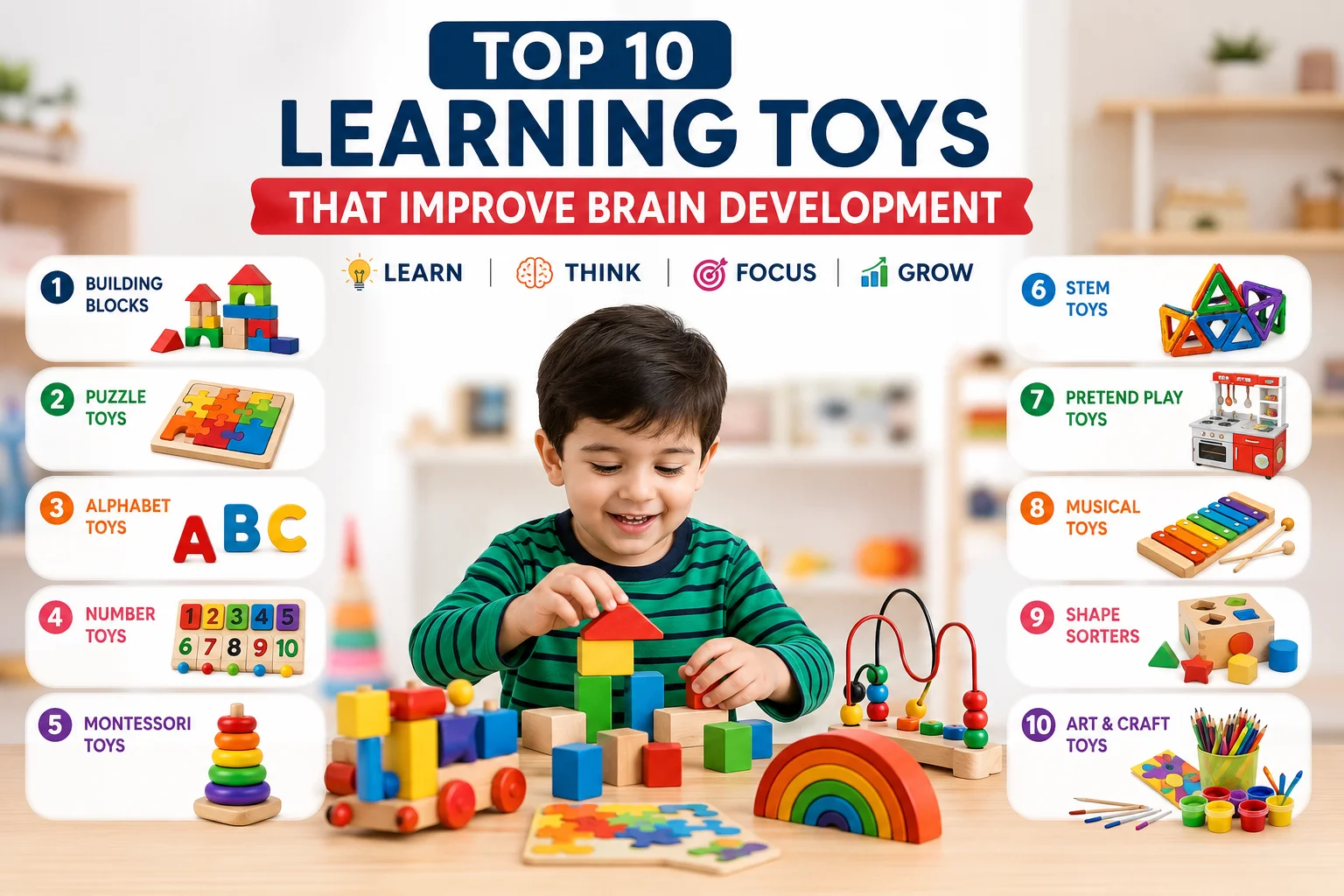
Table of Contents
Every parent wants their child to grow into a confident, creative, and intelligent individual. One of the simplest ways to support a child’s early development is by choosing the Top 10 Learning Toys That Improve Brain Development. Children learn best through play, and the right toys can turn everyday fun into valuable learning experiences.
During the first few years of life, a child’s brain develops at an incredible pace. Experts estimate that nearly 90% of brain development happens before the age of five, making early childhood the perfect time to introduce engaging and educational activities. Instead of relying on screens for entertainment, parents can encourage hands-on learning with carefully selected educational toys for kids that improve memory, creativity, language skills, and problem-solving abilities.
Whether you’re shopping for a birthday gift, planning your child’s learning journey, or simply looking for the best educational toys to keep your little one engaged, this guide will help you make informed decisions. In this article, we’ll explore the Top 10 Learning Toys That Improve Brain Development, explain how each toy benefits growing minds, and provide practical tips to choose the right options for your child.
Why Learning Toys Are Important for Brain Development
Children are naturally curious. They enjoy exploring, asking questions, and experimenting with everything around them. Learning toys take advantage of this curiosity by transforming everyday play into meaningful educational experiences.
Unlike ordinary toys that provide temporary entertainment, learning toys for toddlers are specifically designed to develop important life skills. They encourage children to think independently, solve problems, recognize patterns, improve memory, and communicate effectively.
Educational play also helps children develop confidence. Every time they complete a puzzle, build a tower, recognize a letter, or successfully match shapes, they experience a sense of achievement. These small successes build self-esteem while motivating them to continue learning.
Parents often underestimate how much children learn through play. A simple building block activity can teach balance, planning, patience, and creativity—all at the same time.
How Learning Toys Improve Brain Development
Brain development isn’t just about learning numbers and letters. It involves strengthening neural connections through repeated experiences. Educational toys create opportunities for children to think, explore, and solve challenges independently.
Here are some of the major developmental benefits:
Cognitive Development
The best brain development toys encourage children to observe, analyze, compare, remember, and solve problems. Activities like sorting, stacking, and matching strengthen thinking skills that will later support academic learning.
Language Development
Storytelling toys, alphabet games, flashcards, and pretend play introduce children to new vocabulary and improve communication. Children naturally begin asking questions, describing objects, and expressing their ideas.
Fine Motor Skills
Picking up puzzle pieces, arranging blocks, threading beads, and drawing with crayons improve finger strength and hand-eye coordination. These skills are essential for writing and everyday activities.
Creativity and Imagination
Open-ended toys encourage children to invent stories, build structures, and imagine different situations. Creative play stimulates multiple areas of the brain and improves flexible thinking.
Social and Emotional Development
Many educational toys are designed for group play, helping children learn patience, sharing, teamwork, empathy, and communication.
What Makes a Good Learning Toy?
Not every toy labeled “educational” truly supports learning. Before buying, parents should consider several important factors.
A quality learning toy should:
- Be suitable for the child’s age.
- Encourage active participation instead of passive entertainment.
- Improve one or more developmental skills.
- Allow children to play in multiple ways.
- Be durable and safe.
- Inspire creativity rather than simply following instructions.
- Keep children engaged over time.
The best educational toys grow with the child. A simple set of blocks, for example, can be used differently as a child develops new skills.
Top 10 Learning Toys That Improve Brain Development
1. Building Blocks
Building blocks remain one of the most recommended educational toys for children of all ages. Although they appear simple, they help develop several essential skills simultaneously.
Why Building Blocks Are Great for Brain Development
When children stack blocks, they constantly make decisions. Which block should go first? How can the tower stay balanced? What happens if one block is removed?
Every small decision strengthens logical thinking and problem-solving abilities.
Children also improve:
- Spatial awareness
- Hand-eye coordination
- Fine motor skills
- Creativity
- Concentration
- Patience
Building blocks allow completely open-ended play. Children can build houses, castles, bridges, roads, animals, or anything they imagine.
Ideal Age
2–8 Years
Skills Developed
- Cognitive development
- Creativity
- Engineering basics
- Problem-solving
- Coordination
2. Shape Sorting Toys
Shape sorting toys are among the first educational toys introduced to toddlers because they teach recognition and logical thinking in a fun way.
Children learn to match shapes with corresponding holes while identifying colors and sizes.
Although the activity appears easy, the brain performs several important tasks simultaneously:
- Comparing shapes
- Understanding differences
- Testing possibilities
- Remembering previous attempts
- Improving coordination
These repeated actions strengthen neural pathways responsible for reasoning and visual perception.
Benefits
- Improves concentration
- Develops memory
- Strengthens logical thinking
- Enhances finger control
- Builds confidence
Parents can increase the educational value by naming each shape and color during play.
3. Alphabet Learning Toys
Early literacy begins long before children start school.
Alphabet puzzles, magnetic letters, letter blocks, and interactive alphabet boards introduce children to letters through enjoyable activities instead of memorization.
The biggest advantage is that children associate learning with fun.
Alphabet toys help children:
- Recognize letters
- Learn sounds
- Build vocabulary
- Improve pronunciation
- Prepare for reading
Parents can extend learning by asking children to identify letters from their names or familiar objects around the house.
4. Puzzle Toys
Puzzles are one of the best brain development toys because they encourage children to think carefully before acting.
Every puzzle presents a challenge.
Children observe shapes, compare colors, rotate pieces mentally, and predict where each piece belongs.
These activities activate multiple areas of the brain at once.
Educational Benefits
- Improves concentration
- Strengthens memory
- Develops patience
- Encourages critical thinking
- Builds confidence after completion
Start with large-piece puzzles designed specifically for young children and gradually increase the difficulty as they grow.
Puzzles also encourage independent learning, allowing children to discover solutions without constant adult assistance.
5. Number Learning Toys
Introducing numbers through play is one of the most effective ways to build a strong mathematical foundation. Children learn best when they can see, touch, count, and interact with numbers instead of simply memorizing them.
Number learning toys include counting beads, number puzzles, counting sticks, abacus sets, magnetic numbers, stacking number blocks, and counting games.
These toys help children understand basic mathematical concepts while making learning enjoyable.
How Number Learning Toys Improve Brain Development
When children count objects, they begin to understand relationships between numbers and quantities. This develops logical thinking and analytical skills.
Regular play with number toys improves:
- Number recognition
- Counting skills
- Pattern recognition
- Logical reasoning
- Memory
- Concentration
- Early mathematical thinking
For example, asking your child to count blocks while building a tower helps strengthen both cognitive development and fine motor skills simultaneously.
Activities Parents Can Try
- Count toys while cleaning up.
- Arrange numbers in order.
- Match numbers with objects.
- Create simple addition games using blocks.
- Ask children to identify numbers around the house.
These simple activities make learning natural instead of stressful.
6. Montessori Learning Toys
One of the fastest-growing categories in educational play is Montessori learning toys. These toys are designed to encourage independent learning rather than passive entertainment.
Unlike battery-operated toys that perform actions automatically, Montessori toys require children to think, explore, and solve problems independently.
Examples include:
- Wooden stacking toys
- Practical life activity boards
- Threading toys
- Shape matching boards
- Wooden puzzles
- Sensory learning materials
Why Montessori Toys Support Brain Development
Montessori activities strengthen neural connections because children learn through repetition and exploration.
They improve:
- Focus
- Concentration
- Independence
- Fine motor skills
- Problem-solving
- Confidence
- Logical thinking
Perhaps the biggest advantage is that children learn at their own pace without feeling pressured.
7. STEM Learning Toys
STEM stands for Science, Technology, Engineering, and Mathematics.
Although many parents think STEM toys are only suitable for older children, there are excellent beginner-friendly options for preschoolers.
Popular STEM toys include:
- Magnetic building tiles
- Beginner engineering kits
- Construction toys
- Marble runs
- Coding games without screens
- Simple science experiment kits
How STEM Toys Improve Brain Development
These toys encourage children to ask questions such as:
- Why did this happen?
- What will happen if I change this?
- Can I build something stronger?
- How can I solve this problem?
This kind of thinking develops:
- Creativity
- Engineering skills
- Scientific reasoning
- Problem-solving
- Innovation
- Critical thinking
Instead of giving ready-made answers, STEM toys encourage children to discover solutions themselves.
8. Pretend Play Toys
Pretend play may seem like simple fun, but psychologists consider it one of the most valuable forms of learning during early childhood.
When children pretend to become doctors, chefs, shopkeepers, teachers, or firefighters, they create imaginary situations that improve multiple areas of brain development.
Popular pretend play toys include:
- Kitchen sets
- Doctor kits
- Tool sets
- Grocery shopping sets
- Doll houses
- Cash registers
- Puppet sets
Brain Development Benefits
Pretend play develops:
- Communication skills
- Emotional intelligence
- Creativity
- Vocabulary
- Social skills
- Decision-making
- Imagination
Children also learn empathy by imagining how other people feel.
For example, when a child pretends to treat a sick teddy bear using a doctor kit, they practice kindness, observation, and communication all at once.
9. Musical Learning Toys
Music stimulates several areas of the brain simultaneously.
Simple musical instruments such as xylophones, keyboards, drums, tambourines, maracas, and rhythm sticks provide excellent opportunities for learning.
Benefits of Musical Toys
Children improve:
- Listening skills
- Memory
- Coordination
- Rhythm
- Creativity
- Concentration
Research has shown that musical experiences support language development because both music and speech involve recognizing patterns and sounds.
Parents don’t need expensive instruments.
Even simple rhythm games help strengthen brain connections.
Fun Musical Activities
- Clap along to songs.
- Match different sounds.
- Learn musical patterns.
- Dance while counting beats.
- Create simple family music sessions.
These activities improve both learning and family bonding.
10. Art & Craft Toys
Creative activities activate imagination while strengthening problem-solving skills.
Art encourages children to express ideas that they may not yet be able to explain with words.
Popular art supplies include:
- Coloring books
- Washable crayons
- Finger paints
- Clay
- Stickers
- Child-safe scissors
- Craft papers
- DIY creative kits
Brain Development Benefits
Art activities improve:
- Creativity
- Fine motor skills
- Hand-eye coordination
- Focus
- Emotional expression
- Color recognition
- Confidence
Every drawing represents independent thinking.
Instead of telling children exactly what to create, allow them to experiment freely.
Creativity grows when there are no “wrong answers.”
Comparison Table: Top 10 Learning Toys That Improve Brain Development
| Learning Toy | Primary Skill | Best Age Group |
| Building Blocks | Creativity & Problem Solving | 2–8 Years |
| Shape Sorters | Logical Thinking | 2–4 Years |
| Alphabet Toys | Language Development | 3–6 Years |
| Puzzle Toys | Memory & Concentration | 3–8 Years |
| Number Learning Toys | Early Math Skills | 3–6 Years |
| Montessori Toys | Independent Learning | 2–6 Years |
| STEM Toys | Critical Thinking | 4–10 Years |
| Pretend Play Toys | Communication & Social Skills | 3–8 Years |
| Musical Toys | Listening & Creativity | 2–7 Years |
| Art & Craft Kits | Imagination & Motor Skills | 3–10 Years |
Benefits of Educational Toys Beyond Brain Development
While improving intelligence is one of the biggest goals, educational toys offer many additional advantages.
Children who regularly engage with educational toys for kids often develop stronger life skills that help them both inside and outside the classroom.
Some important benefits include:
Improved Attention Span
Children learn to stay focused on one activity for longer periods.
Better Problem-Solving Skills
They begin experimenting with different solutions instead of giving up easily.
Increased Confidence
Successfully completing challenges gives children confidence in their own abilities.
Better Communication
Interactive learning toys encourage conversations between parents and children.
Reduced Screen Time
Interesting learning activities naturally reduce dependence on mobile phones and tablets.
Stronger Parent-Child Bond
Playing together creates meaningful learning experiences and lasting memories.
Complete Guide: Choosing the Best Learning Toys
Buying educational toys isn’t about purchasing the most expensive product.
Instead, parents should consider quality, safety, and developmental value.
1. Buy According to Age
Always check the recommended age printed on the packaging.
Age-appropriate toys keep children engaged without causing frustration.
2. Focus on Open-Ended Play
Choose toys that can be used in multiple ways.
Examples include:
- Blocks
- Clay
- Wooden toys
- Magnetic tiles
These toys continue supporting creativity as children grow.
3. Prioritize Safety
Always look for:
- BPA-free materials
- Non-toxic paint
- Rounded edges
- Durable construction
- No small detachable parts for younger children
4. Choose Durable Toys
Good educational toys often last for years and can even be passed down to younger siblings.
5. Buy According to Your Child’s Interests
Some children enjoy building.
Others love drawing.
Some prefer pretend play.
Observe your child’s natural interests before purchasing new toys.
Learning becomes much more effective when children are genuinely interested.
Common Mistakes Parents Make
Many parents unintentionally reduce the educational value of toys by making common purchasing mistakes.
Avoid these:
- Buying too many toys at once.
- Choosing toys only because they’re trending.
- Ignoring safety standards.
- Purchasing toys beyond the child’s developmental level.
- Depending entirely on electronic toys.
- Not participating in playtime.
- Replacing toys too frequently.
- Expecting instant learning results.
Remember, consistency is more important than quantity.
Even a few carefully selected brain development toys can have a significant positive impact when used regularly.
Expert Tips to Maximize Learning Through Play
Buying the best educational toys is only the first step. How children use those toys plays an equally important role in their overall development. Parents and caregivers can make learning more meaningful by actively participating in playtime and creating a positive learning environment.
Here are some expert-recommended strategies to help children get the most from their learning toys.
1. Play Together Every Day
Even 20–30 minutes of quality playtime each day can significantly improve a child’s cognitive and emotional development. Ask questions, encourage conversations, and celebrate their achievements.
Instead of showing them how to solve every problem, let them explore different solutions on their own.
2. Encourage Curiosity
Children naturally ask questions like:
- Why?
- How?
- What happens if…?
Rather than giving immediate answers, encourage them to think and experiment. This develops analytical thinking and confidence.
3. Rotate Toys Regularly
Children don’t need dozens of toys available all the time.
A toy rotation system keeps learning exciting while reducing clutter.
For example:
- Week 1: Building Blocks + Puzzle Toys
- Week 2: Alphabet & Number Toys
- Week 3: Pretend Play Sets
- Week 4: Art & Craft Kits
Rotating toys every 1–2 weeks makes old toys feel new again and keeps children interested.
4. Create a Screen-Free Learning Environment
While digital devices have educational uses, young children benefit most from hands-on experiences.
Replacing even 30 minutes of daily screen time with educational play can improve attention span, creativity, and communication skills.
5. Praise Effort, Not Just Results
Instead of saying:
“You’re so smart!”
Try saying:
“I like how you kept trying until you solved the puzzle.”
This encourages a growth mindset and helps children enjoy learning without fearing mistakes.
Age-Wise Learning Toy Recommendations
Choosing toys based on age ensures children remain challenged without becoming frustrated.
2–3 Years
Recommended toys:
- Shape Sorters
- Large Building Blocks
- Wooden Puzzles
- Musical Toys
- Stacking Rings
- Color Matching Games
Focus on:
- Fine motor skills
- Color recognition
- Hand-eye coordination
- Basic vocabulary
3–5 Years
This is one of the most important stages of early learning.
Recommended toys:
- Alphabet Learning Toys
- Number Learning Toys
- Pretend Play Sets
- Montessori Toys
- Art & Craft Kits
- Beginner STEM Toys
Focus on:
- Language development
- Creativity
- Memory
- Logical thinking
- Communication
5–7 Years
As children grow, they enjoy solving more complex challenges.
Recommended toys:
- STEM Construction Kits
- Magnetic Tiles
- Science Experiment Kits
- Strategy Board Games
- Advanced Building Blocks
Focus on:
- Problem-solving
- Teamwork
- Scientific thinking
- Engineering concepts
- Critical reasoning
How to Create the Perfect Learning Corner at Home
You don’t need a large playroom to encourage learning.
A small, organized learning corner can make a huge difference.
Include:
- A bookshelf
- Storage baskets
- Building blocks
- Art supplies
- Puzzle shelf
- Reading corner
- Soft floor mat
Keep toys organized and easily accessible so children can choose activities independently.
Adding good lighting and a comfortable seating area also helps create a welcoming environment.
Signs That a Learning Toy Is Helping Your Child
Parents often ask how they can tell whether an educational toy is truly beneficial.
Look for these positive signs:
- Your child returns to the toy repeatedly.
- They become more focused during play.
- They ask more questions.
- They solve challenges independently.
- They create new ways to play.
- They use imagination while playing.
- They explain what they are doing.
- They stay engaged for longer periods.
These behaviors indicate that the toy is encouraging active learning rather than passive entertainment.
Why Educational Toys Are Better Than Excessive Screen Time
Modern technology is part of everyday life, but excessive screen exposure during early childhood can reduce opportunities for active exploration.
Educational toys provide several advantages over passive screen entertainment.
| Educational Toys | Excessive Screen Time |
| Encourages creativity | Mostly passive entertainment |
| Improves motor skills | Limited physical movement |
| Supports social interaction | Often solitary activity |
| Builds problem-solving skills | Ready-made solutions |
| Develops imagination | Less imaginative play |
| Improves concentration | Frequent distractions |
A healthy balance between educational play and limited, age-appropriate screen use is the best approach.
Final Thoughts
The Top 10 Learning Toys That Improve Brain Development are much more than simple playthings—they are valuable tools that help children build essential skills for life. From improving memory and creativity to strengthening language, motor skills, and problem-solving abilities, the right toys make learning enjoyable and meaningful.
Remember that no single toy can teach everything. A balanced collection of learning toys for toddlers, educational toys for kids, Montessori learning toys, and brain development toys gives children opportunities to explore different interests and abilities.
As a parent, your involvement matters just as much as the toys themselves. Spending quality time playing, asking questions, encouraging curiosity, and celebrating progress creates a positive learning environment where children can thrive.
When selecting toys, always prioritize:
- Safety
- Age-appropriateness
- Open-ended play
- Quality over quantity
- Long-term educational value
By making thoughtful choices today, you’re helping build the foundation for your child’s confidence, creativity, and lifelong love of learning.
Frequently Asked Questions (FAQs)
1. What are the best learning toys for brain development?
Building blocks, puzzles, Montessori toys, STEM kits, alphabet boards, number games, musical instruments, pretend play sets, shape sorters, and art & craft kits are among the best learning toys for supporting brain development.
2. At what age should children start using educational toys?
Children can begin using age-appropriate educational toys from infancy. Simple stacking toys, sensory toys, and shape sorters are ideal for toddlers, while preschoolers can enjoy alphabet, number, and STEM-based learning toys.
3. Do learning toys really improve intelligence?
Learning toys support cognitive development by improving memory, problem-solving, creativity, concentration, and language skills. While they don’t directly increase IQ, they help build essential abilities that contribute to overall learning and development.
4. Which toy is best for improving memory?
Puzzles, memory matching games, building blocks, alphabet cards, and sequencing games are excellent for strengthening memory and concentration.
5. Are Montessori toys worth buying?
Yes. Montessori toys encourage independent learning, logical thinking, focus, and practical life skills. Their simple, hands-on design helps children learn through exploration rather than passive entertainment.
6. How many educational toys should a child have?
A small collection of 10–15 high-quality educational toys is usually enough. Rotating toys every few weeks keeps children interested and prevents overstimulation.
7. How much screen time should preschool children have?
Health experts generally recommend limiting recreational screen time and encouraging active, hands-on play. Educational toys, reading, and outdoor activities are healthier alternatives for early childhood development.
8. How do educational toys improve creativity?
Open-ended toys such as building blocks, art kits, and pretend play sets encourage children to imagine, experiment, and create their own stories, helping develop creative thinking and self-expression.
9. What safety features should parents look for when buying toys?
Choose toys made from non-toxic materials with rounded edges, durable construction, and age-appropriate designs. Avoid products with small detachable parts for younger children.
10. What are the best educational toys for toddlers?
Shape sorters, stacking rings, building blocks, musical toys, wooden puzzles, and sensory toys are excellent choices for toddlers because they improve motor skills, coordination, and early cognitive development.
11. Are STEM toys suitable for young children?
Yes. Beginner STEM toys designed for preschoolers introduce basic concepts of science, engineering, and problem-solving through fun, hands-on activities.
12. Can educational toys help reduce screen time?
Absolutely. Engaging learning toys provide children with enjoyable alternatives to mobile phones and tablets, encouraging creativity and active participation instead of passive screen use.
13. How can parents make educational toys more effective?
Play with your child, ask open-ended questions, rotate toys regularly, encourage independent thinking, and praise effort instead of perfection to maximize the learning benefits.
14. Where can I buy quality educational toys online?
Purchase from trusted online toy stores that provide clear product descriptions, age recommendations, customer reviews, and safety information to ensure you’re choosing the right toys for your child.
15. Why is play important for brain development?
Play strengthens neural connections, improves memory, enhances communication, supports emotional growth, and encourages creativity. It is one of the most effective ways for children to learn during their early years.
Foloow us on


